 I
grew up in King William County, a small rural area about an hour outside of Richmond.
King William is sometimes referred to with the nickname of “Killa Weed”. Can
you guess why? The answer is pretty obvious, it’s a place where a lot of weed is grown, sold, and smoked. In high school I was probably the only person
in my friend group who had never smoked weed before. Most of my friends started
smoking in seventh and eighth grade and still continue use to this day. I never
had any strong opinions about weed one way or the other, I just wasn't interested
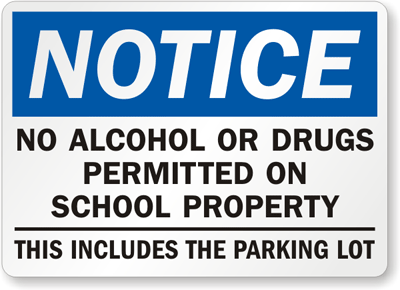
in smoking. Pulling into the school parking lot at 8 am every morning, it wouldn't be out of the ordinary to kids smoking a
I
grew up in King William County, a small rural area about an hour outside of Richmond.
King William is sometimes referred to with the nickname of “Killa Weed”. Can
you guess why? The answer is pretty obvious, it’s a place where a lot of weed is grown, sold, and smoked. In high school I was probably the only person
in my friend group who had never smoked weed before. Most of my friends started
smoking in seventh and eighth grade and still continue use to this day. I never
had any strong opinions about weed one way or the other, I just wasn't interested
in smoking. Pulling into the school parking lot at 8 am every morning, it wouldn't be out of the ordinary to kids smoking a
A
study was conducted on 1,161 students from different urban and suburban area
schools to see the effects of marijuana use in school on behavior in school
compared to no marijuana use and general use of the substance outside of
school. 767 students reported no marijuana use, and of the 394 students who
reported general use, 191 used in school. The five indicators of behavior in the study
were: academic achievement, classroom participation, punishment in school,
nonattendance, and cheating. Students self-reported these results on different
scales related to the behavior. The results
showed that students who used marijuana in school exhibited inferior behavior
in each
category compared to those who did not use at all. The biggest difference was
found in punishment in school, which come as no surprise since these students
participate in illicit drug use on school property. The results also show that
those students had lower grades, less class participation, worse attendance and
more academic dishonesty than their peers.
All
research has its limitations and this study was no exception. Because it was non-
experimental, questions could be raised as to whether poor academics and
behavior are a result of marijuana use, or if in some cases, poor academics and
behavior led to marijuana use. This study also involved the use of
self-reporting by the student. There may have been personal bias and the
student could have under or over reported their marijuana use or school behaviors.
 Now
that we have this information, what are we to do with it? I think it is
important to ask why students feel comfortable using an illegal substance
casually in school. You rarely hear of instances where high school teens shoot heroin
or snort cocaine in the parking lot before heading to class, but the use of use
of marijuana is more common. Before taking a substance abuse class in college, I
would, like many of my peers back home ask why not? In the media or and in school
you rarely hear of marijuana in negative context (If it is talked about at all).
There are plenty of anti-smoking campaigns and commercials, but there is an absence
of focus on marijuana. Lack of knowledge about the effects of marijuana could
be hindering advocacy against its use. We can easily see the consequences of
smoking in apparent forms such as cancer. But the effects of marijuana may not
be so easily seen. I think that the information in this study could be used as
clear implications as to why marijuana is a harmful substance. This could lead
to better education on the substance and result in a decrease of its use.
Now
that we have this information, what are we to do with it? I think it is
important to ask why students feel comfortable using an illegal substance
casually in school. You rarely hear of instances where high school teens shoot heroin
or snort cocaine in the parking lot before heading to class, but the use of use
of marijuana is more common. Before taking a substance abuse class in college, I
would, like many of my peers back home ask why not? In the media or and in school
you rarely hear of marijuana in negative context (If it is talked about at all).
There are plenty of anti-smoking campaigns and commercials, but there is an absence
of focus on marijuana. Lack of knowledge about the effects of marijuana could
be hindering advocacy against its use. We can easily see the consequences of
smoking in apparent forms such as cancer. But the effects of marijuana may not
be so easily seen. I think that the information in this study could be used as
clear implications as to why marijuana is a harmful substance. This could lead
to better education on the substance and result in a decrease of its use.
No comments:
Post a Comment